
# Technical Architecture and Performance Analysis of Professional HDMI IPTV Encoder Hardware for High Definition Digital Broadcasting
The digital video broadcasting ecosystem is experiencing a massive evolution as media operators, hospitality venues, enterprise corporations, and streaming providers transition away from legacy coaxial distribution toward internet protocol video streaming networks. Converting uncompressed HDMI video signals from cameras, media players, satellite receivers, and gaming consoles into digital IP streams is the fundamental requirement for modern video broadcasting. Deploying a professional hdmi iptv encoder serves as the core hardware bridge that ingests raw video feeds and converts them into optimized data streams for local area networks and global cloud distribution. Evaluating professional hdmi iptv encoder systems requires analyzing vital engineering specifications including hardware compression chipsets, multi protocol IP streaming capabilities, audio video synchronization, stream latency management, and continuous operating stability under heavy broadcast loads. High performance encoding units must ingest high bitrate HDMI sources cleanly while maintaining pristine visual clarity without video freeze or frame loss during long broadcast sessions. In this detailed technical analysis, we examine how professional hdmi iptv encoder units process media feeds, review essential performance benchmarks, outline step by step configuration procedures, answer common operator questions, and explain why pairing hardware encoders with the Eagle4k cloud distribution network guarantees maximum stream stability and crystal clear four K picture delivery.
## Understanding the Hardware Architecture of a Professional HDMI IPTV Encoder
To understand how high quality video conversion operates, it is necessary to examine the internal hardware design of a professional hdmi iptv encoder. Traditional video capture setups rely on consumer level capture cards connected to desktop computers, which suffer from operating system instabilities, high CPU thermal loads, and unpredictable stream dropouts.
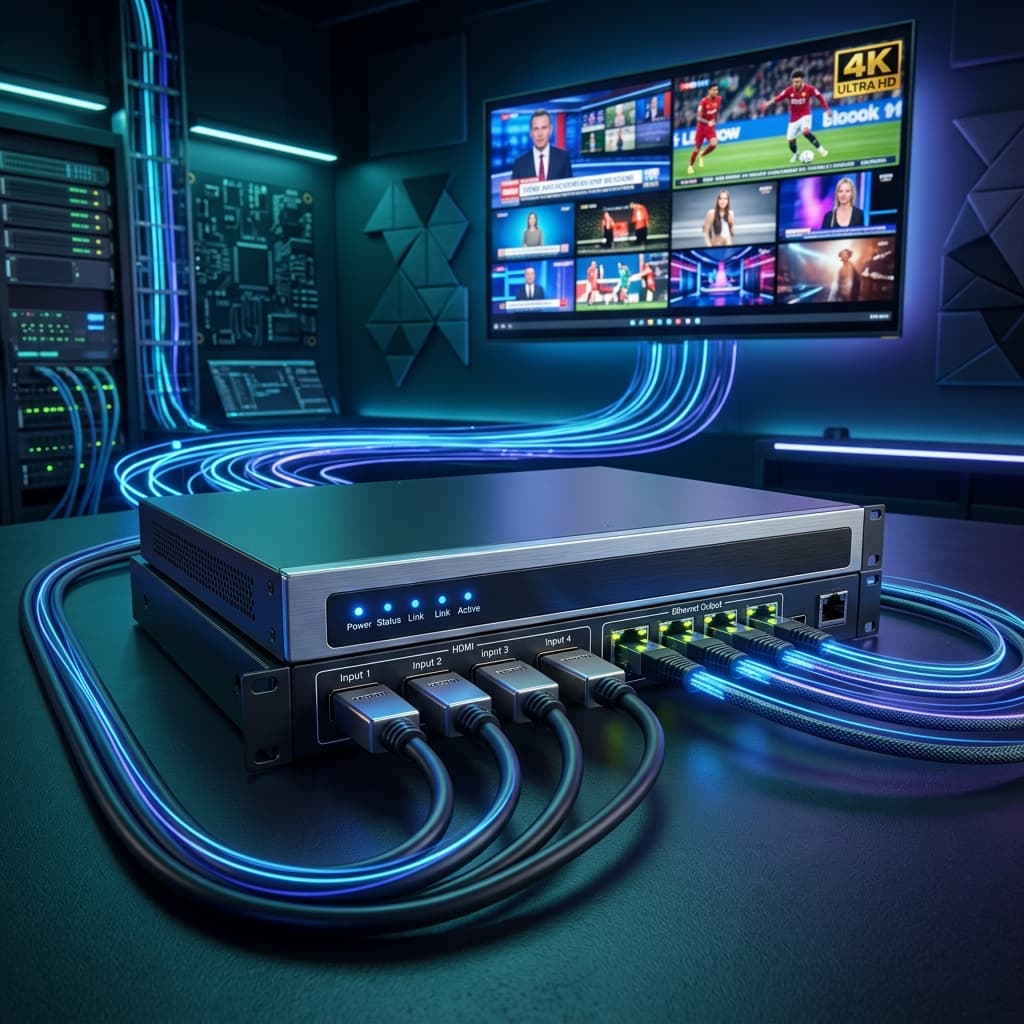
In contrast, a dedicated professional hdmi iptv encoder is built on an enterprise hardware platform powered by specialized system on chip processors and hardware encoding modules designed specifically for non stop video conversion. When an uncompressed HDMI digital video and audio signal enters the input port, the professional hdmi iptv encoder immediately routes the raw stream into hardware processing units. The video data is compressed using High Efficiency Video Coding H265 or High Definition H264 compression standards, while audio signals are encoded into Advanced Audio Coding AAC formats. By performing hardware acceleration directly inside the standalone encoder chassis, processing delay is minimized to a tiny fraction of a second. The compressed media streams are then encapsulated into standard IP network transport protocols such as SRT, RTSP, UDP multicast, HTTP, or RTMP. These structured IP data packets travel directly across local network switches or cloud edge servers, enabling subscriber media players and Smart TVs to decode and display smooth video feeds with instant channel switching response.
## Essential Evaluation Criteria for Selecting Professional HDMI IPTV Encoder Systems
Selecting the ideal hardware encoding appliance requires evaluating primary engineering capabilities designed for commercial and enterprise video distribution. Here are the primary technical parameters that define a top tier professional hdmi iptv encoder.
1. High Resolution Video Ingestion and Hardware Compression. Enterprise processing chipsets allow a professional hdmi iptv encoder to capture full high definition and four K Ultra HD video sources at sixty frames per second with vibrant color accuracy and zero frame drops.
2. Comprehensive IP Network Protocol Support. Support for diverse streaming transport protocols including SRT, RTSP, UDP multicast, RTMP, and HLS enables a professional hdmi iptv encoder to integrate seamlessly into diverse networking environments.
3. Advanced H265 HEVC Compression Efficiency. Deploying modern H265 video compression algorithms allows a professional hdmi iptv encoder to maintain superior picture quality while cutting bandwidth consumption by up to fifty percent compared to legacy H264 units.
4. Flexible Bitrate Control and Dual Stream Output. Support for constant bitrate and variable bitrate modes allows a professional hdmi iptv encoder to send high resolution primary streams while simultaneously outputting lower bitrate secondary streams for mobile display devices.
5. Commercial Grade Hardware Reliability and Heat Dissipation. Heavy duty aluminum alloy casing and passive cooling designs enable a professional hdmi iptv encoder to operate continuously twenty four hours a day without thermal degradation.
## Stream Transport Protocols and Network Deployment of Professional HDMI IPTV Encoder Units
Selecting appropriate network transport protocols is essential for maximizing stream stability and delivering smooth video across enterprise networks and public internet connections. Traditional uncompressed video feeds require immense bandwidth, making direct transmission over wide area networks impractical.
Modern professional hdmi iptv encoder devices resolve network bandwidth challenges by utilizing advanced IP packetization protocols. When operating within localized enterprise environments such as hotels, corporate campuses, or sports arenas, configuring a professional hdmi iptv encoder to output UDP multicast or RTSP streams enables thousands of end user screens to display the same live broadcast without overloading network switches. When transmitting video streams across public internet backbones to distant media servers, setting the professional hdmi iptv encoder to SRT mode provides built in packet loss recovery, ARQ error correction, and AES encryption. This ensures high definition video streams reach target cloud servers smoothly even when traveling across high jitter or lossy internet connections.
## Integrating Professional HDMI IPTV Encoder Technology with Eagle4k Infrastructure
While deploying a reliable professional hdmi iptv encoder guarantees high quality local video encoding, delivering these live streams to worldwide audience displays requires a robust global streaming infrastructure. Subpar server networks can introduce buffering bottlenecks and channel delay, reducing overall broadcast quality.
Pairing a professional hdmi iptv encoder with the Eagle4k cloud distribution network creates an end to end media delivery pipeline. Eagle4k operates distributed edge server clusters equipped with Anti Freeze version nine acceleration software. When the output stream from a professional hdmi iptv encoder reaches Eagle4k cloud ingestion points, Intelligent Traffic Routing automatically distributes data packets along ultra fast fiber optic backbones directly to end user media applications. This combination guarantees ninety nine point ninety nine percent server uptime, instantaneous channel switching speeds, and buffer free four K streaming performance for subscribers across all major display platforms.
## Step by Step Workflow for Configuring Professional HDMI IPTV Encoder Appliances
Setting up a professional hdmi iptv encoder for live video streaming across your network is a simple process that takes under five minutes. Follow these logical steps to start broadcasting your HDMI video feed.
1. Connect your HDMI video source device such as a camera or satellite receiver directly into the HDMI input port of your professional hdmi iptv encoder.
2. Connect a standard Ethernet network cable from the LAN port of the encoder to your local network switch or router.
3. Connect the power adapter to turn on the professional hdmi iptv encoder and view the default static IP address on the hardware label or status display screen.
4. Open a web browser on your computer connected to the same network and enter the encoder IP address into the location bar.
5. Log into the web management interface and navigate to the video encoding settings panel.
6. Select H265 HEVC as the primary video encoding format and set your desired resolution to four K or full high definition.
7. Configure the stream output protocol to SRT or RTSP, entering the destination server URL and port details provided by your Eagle4k distribution panel.
8. Save the configuration parameters and click start to initiate live encoding and broadcast your video feed.
## Frequently Asked Questions About Professional HDMI IPTV Encoder Hardware
Question one. What is a professional hdmi iptv encoder and how does it function.
Answer. A professional hdmi iptv encoder is a standalone hardware device that ingests high definition HDMI audio and video signals, compresses the media using hardware codecs like H265 or H264, and streams digital IP packets over local networks or the internet.
Question two. What video resolutions and frame rates are supported by a professional hdmi iptv encoder.
Answer. Enterprise professional hdmi iptv encoder units support resolutions ranging from standard high definition up to true four K Ultra HD video at sixty frames per second, ensuring smooth motion capture for live sports and action video feeds.
Question three. What is the difference between hardware encoding and software encoding for HDMI video.
Answer. Hardware encoding performed by a professional hdmi iptv encoder uses dedicated silicon processing chips that operate independently without needing a computer, providing superior uptime, lower latency, and zero system crash risk compared to computer software encoding.
Question four. Can a professional hdmi iptv encoder stream directly to Smart TVs and media player apps.
Answer. Yes, a professional hdmi iptv encoder can output standard RTSP, UDP multicast, or HLS streams that are decoded natively by Smart TV applications, Firesticks, and popular IPTV media players like TiviMate or IPTV Smarters Pro.
Question five. Why is pairing a professional hdmi iptv encoder with Eagle4k recommended for live streaming.
Answer. Pairing a professional hdmi iptv encoder with Eagle4k provides global edge distribution, Anti Freeze version nine technology, and high bandwidth network routing, ensuring live streams reach thousands of viewers with rock solid reliability and pristine visual quality.
## Summary and Final System Recommendations
In summary, selecting a high quality professional hdmi iptv encoder is the single most important hardware decision for organizations seeking to broadcast crystal clear HDMI video feeds over IP networks. By leveraging dedicated hardware acceleration, advanced H265 compression, and versatile streaming protocol support, standalone hardware encoders deliver unmatched reliability and low delay performance. Connecting your professional hdmi iptv encoder to the cloud distribution network at Eagle4k ensures seamless global reach, ninety nine point ninety nine percent uptime, and pristine four K viewing quality across all user displays.
The digital video broadcasting ecosystem is experiencing a massive evolution as media operators, hospitality venues, enterprise corporations, and streaming providers transition away from legacy coaxial distribution toward internet protocol video streaming networks. Converting uncompressed HDMI video signals from cameras, media players, satellite receivers, and gaming consoles into digital IP streams is the fundamental requirement for modern video broadcasting. Deploying a professional hdmi iptv encoder serves as the core hardware bridge that ingests raw video feeds and converts them into optimized data streams for local area networks and global cloud distribution. Evaluating professional hdmi iptv encoder systems requires analyzing vital engineering specifications including hardware compression chipsets, multi protocol IP streaming capabilities, audio video synchronization, stream latency management, and continuous operating stability under heavy broadcast loads. High performance encoding units must ingest high bitrate HDMI sources cleanly while maintaining pristine visual clarity without video freeze or frame loss during long broadcast sessions. In this detailed technical analysis, we examine how professional hdmi iptv encoder units process media feeds, review essential performance benchmarks, outline step by step configuration procedures, answer common operator questions, and explain why pairing hardware encoders with the Eagle4k cloud distribution network guarantees maximum stream stability and crystal clear four K picture delivery.
## Understanding the Hardware Architecture of a Professional HDMI IPTV Encoder
To understand how high quality video conversion operates, it is necessary to examine the internal hardware design of a professional hdmi iptv encoder. Traditional video capture setups rely on consumer level capture cards connected to desktop computers, which suffer from operating system instabilities, high CPU thermal loads, and unpredictable stream dropouts.
In contrast, a dedicated professional hdmi iptv encoder is built on an enterprise hardware platform powered by specialized system on chip processors and hardware encoding modules designed specifically for non stop video conversion. When an uncompressed HDMI digital video and audio signal enters the input port, the professional hdmi iptv encoder immediately routes the raw stream into hardware processing units. The video data is compressed using High Efficiency Video Coding H265 or High Definition H264 compression standards, while audio signals are encoded into Advanced Audio Coding AAC formats. By performing hardware acceleration directly inside the standalone encoder chassis, processing delay is minimized to a tiny fraction of a second. The compressed media streams are then encapsulated into standard IP network transport protocols such as SRT, RTSP, UDP multicast, HTTP, or RTMP. These structured IP data packets travel directly across local network switches or cloud edge servers, enabling subscriber media players and Smart TVs to decode and display smooth video feeds with instant channel switching response.
## Essential Evaluation Criteria for Selecting Professional HDMI IPTV Encoder Systems
Selecting the ideal hardware encoding appliance requires evaluating primary engineering capabilities designed for commercial and enterprise video distribution. Here are the primary technical parameters that define a top tier professional hdmi iptv encoder.
1. High Resolution Video Ingestion and Hardware Compression. Enterprise processing chipsets allow a professional hdmi iptv encoder to capture full high definition and four K Ultra HD video sources at sixty frames per second with vibrant color accuracy and zero frame drops.
2. Comprehensive IP Network Protocol Support. Support for diverse streaming transport protocols including SRT, RTSP, UDP multicast, RTMP, and HLS enables a professional hdmi iptv encoder to integrate seamlessly into diverse networking environments.
3. Advanced H265 HEVC Compression Efficiency. Deploying modern H265 video compression algorithms allows a professional hdmi iptv encoder to maintain superior picture quality while cutting bandwidth consumption by up to fifty percent compared to legacy H264 units.
4. Flexible Bitrate Control and Dual Stream Output. Support for constant bitrate and variable bitrate modes allows a professional hdmi iptv encoder to send high resolution primary streams while simultaneously outputting lower bitrate secondary streams for mobile display devices.
5. Commercial Grade Hardware Reliability and Heat Dissipation. Heavy duty aluminum alloy casing and passive cooling designs enable a professional hdmi iptv encoder to operate continuously twenty four hours a day without thermal degradation.
## Stream Transport Protocols and Network Deployment of Professional HDMI IPTV Encoder Units
Selecting appropriate network transport protocols is essential for maximizing stream stability and delivering smooth video across enterprise networks and public internet connections. Traditional uncompressed video feeds require immense bandwidth, making direct transmission over wide area networks impractical.
Modern professional hdmi iptv encoder devices resolve network bandwidth challenges by utilizing advanced IP packetization protocols. When operating within localized enterprise environments such as hotels, corporate campuses, or sports arenas, configuring a professional hdmi iptv encoder to output UDP multicast or RTSP streams enables thousands of end user screens to display the same live broadcast without overloading network switches. When transmitting video streams across public internet backbones to distant media servers, setting the professional hdmi iptv encoder to SRT mode provides built in packet loss recovery, ARQ error correction, and AES encryption. This ensures high definition video streams reach target cloud servers smoothly even when traveling across high jitter or lossy internet connections.
## Integrating Professional HDMI IPTV Encoder Technology with Eagle4k Infrastructure
While deploying a reliable professional hdmi iptv encoder guarantees high quality local video encoding, delivering these live streams to worldwide audience displays requires a robust global streaming infrastructure. Subpar server networks can introduce buffering bottlenecks and channel delay, reducing overall broadcast quality.
Pairing a professional hdmi iptv encoder with the Eagle4k cloud distribution network creates an end to end media delivery pipeline. Eagle4k operates distributed edge server clusters equipped with Anti Freeze version nine acceleration software. When the output stream from a professional hdmi iptv encoder reaches Eagle4k cloud ingestion points, Intelligent Traffic Routing automatically distributes data packets along ultra fast fiber optic backbones directly to end user media applications. This combination guarantees ninety nine point ninety nine percent server uptime, instantaneous channel switching speeds, and buffer free four K streaming performance for subscribers across all major display platforms.
## Step by Step Workflow for Configuring Professional HDMI IPTV Encoder Appliances
Setting up a professional hdmi iptv encoder for live video streaming across your network is a simple process that takes under five minutes. Follow these logical steps to start broadcasting your HDMI video feed.
1. Connect your HDMI video source device such as a camera or satellite receiver directly into the HDMI input port of your professional hdmi iptv encoder.
2. Connect a standard Ethernet network cable from the LAN port of the encoder to your local network switch or router.
3. Connect the power adapter to turn on the professional hdmi iptv encoder and view the default static IP address on the hardware label or status display screen.
4. Open a web browser on your computer connected to the same network and enter the encoder IP address into the location bar.
5. Log into the web management interface and navigate to the video encoding settings panel.
6. Select H265 HEVC as the primary video encoding format and set your desired resolution to four K or full high definition.
7. Configure the stream output protocol to SRT or RTSP, entering the destination server URL and port details provided by your Eagle4k distribution panel.
8. Save the configuration parameters and click start to initiate live encoding and broadcast your video feed.
## Frequently Asked Questions About Professional HDMI IPTV Encoder Hardware
Question one. What is a professional hdmi iptv encoder and how does it function.
Answer. A professional hdmi iptv encoder is a standalone hardware device that ingests high definition HDMI audio and video signals, compresses the media using hardware codecs like H265 or H264, and streams digital IP packets over local networks or the internet.
Question two. What video resolutions and frame rates are supported by a professional hdmi iptv encoder.
Answer. Enterprise professional hdmi iptv encoder units support resolutions ranging from standard high definition up to true four K Ultra HD video at sixty frames per second, ensuring smooth motion capture for live sports and action video feeds.
Question three. What is the difference between hardware encoding and software encoding for HDMI video.
Answer. Hardware encoding performed by a professional hdmi iptv encoder uses dedicated silicon processing chips that operate independently without needing a computer, providing superior uptime, lower latency, and zero system crash risk compared to computer software encoding.
Question four. Can a professional hdmi iptv encoder stream directly to Smart TVs and media player apps.
Answer. Yes, a professional hdmi iptv encoder can output standard RTSP, UDP multicast, or HLS streams that are decoded natively by Smart TV applications, Firesticks, and popular IPTV media players like TiviMate or IPTV Smarters Pro.
Question five. Why is pairing a professional hdmi iptv encoder with Eagle4k recommended for live streaming.
Answer. Pairing a professional hdmi iptv encoder with Eagle4k provides global edge distribution, Anti Freeze version nine technology, and high bandwidth network routing, ensuring live streams reach thousands of viewers with rock solid reliability and pristine visual quality.
## Summary and Final System Recommendations
In summary, selecting a high quality professional hdmi iptv encoder is the single most important hardware decision for organizations seeking to broadcast crystal clear HDMI video feeds over IP networks. By leveraging dedicated hardware acceleration, advanced H265 compression, and versatile streaming protocol support, standalone hardware encoders deliver unmatched reliability and low delay performance. Connecting your professional hdmi iptv encoder to the cloud distribution network at Eagle4k ensures seamless global reach, ninety nine point ninety nine percent uptime, and pristine four K viewing quality across all user displays.