
# Technical Overview of H.264 HDMI IPTV Encoder Hardware for Seamless HD Video Distribution
In modern video engineering, corporate media networks, educational institutions, hospitality facilities, and digital signage deployments, streaming high quality audio and video feeds across local network switches requires proven hardware compression technology. A dedicated h.264 hdmi iptv encoder is a specialized electronic hardware appliance engineered to capture uncompressed High Definition video and digital audio from an HDMI input source, compress the data stream using universal H264 AVC compression algorithms, and transmit IP data packets across standard ethernet infrastructure. Utilizing a professional h.264 hdmi iptv encoder enables system administrators to bypass traditional HDMI cable length restrictions, transmit low latency video across existing local network switches, and broadcast live streams directly to Smart TVs, computers, media decoders, and cloud distribution platforms. In this detailed educational overview, we examine how h.264 hdmi iptv encoder hardware operates, detail essential technical specifications, outline step by step setup workflows, answer common engineering questions, and explain why pairing hardware encoders with edge platforms like Eagle4k guarantees exceptional streaming stability.
## Understanding the Core Architecture Behind H.264 HDMI IPTV Encoder Systems
To evaluate why H264 compression remains the most widely deployed video encoding standard globally, it is helpful to examine how an h.264 hdmi iptv encoder processes physical media signals into internet protocol packets. Traditional video setups require running long physical HDMI cables from media sources like satellite receivers, computers, digital switchers, or media players to display screens. However, physical HDMI signals degrade significantly over extended cable distances and require expensive HDMI matrix hardware to feed multiple monitors simultaneously.
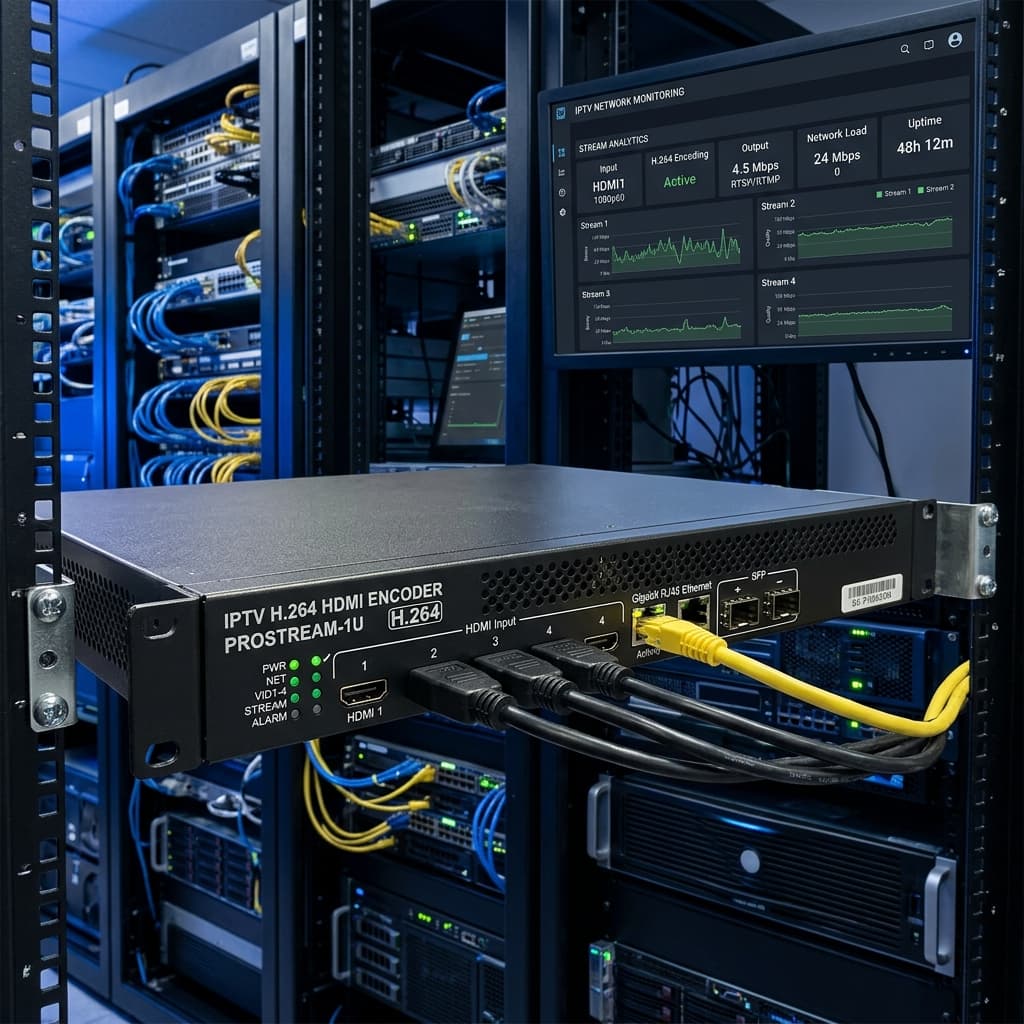
An h.264 hdmi iptv encoder resolves these physical limitations by ingesting raw digital video signals through its HDMI input port. Inside the appliance, specialized hardware digital signal processing chips compress incoming video frames using Advanced Video Coding algorithms, commonly known as H264 AVC. The hardware compresses the media while maintaining crisp 1080p High Definition video resolutions. Once encoded, the hardware encapsulates the compressed video packets into standardized streaming protocols including UDP multicast, RTP, RTSP, RTMP, HLS, or SRT. The encoder outputs these IP packets via a standard RJ45 Gigabit ethernet interface onto local network switches. Any compatible media receiver, Smart TV, or software decoder connected to the network can ingest and render the live stream in real time.
## Essential Features and Technical Parameters of an H.264 HDMI IPTV Encoder
Selecting the optimal h.264 hdmi iptv encoder requires evaluating several critical hardware parameters and operational capabilities. Here are the core specifications associated with professional encoder units.
1. Universal Hardware Decoding Compatibility. The primary advantage of an h.264 hdmi iptv encoder is universal decoder support. Nearly every Smart TV, legacy set top box, smartphone, tablet, and web browser natively decodes H264 video without requiring specialized software plugins or heavy CPU decoding power.
2. Full 1080p HD Resolution at Sixty Frames Per Second. High performance h.264 hdmi iptv encoder models support full 1920 by 1080 resolution at sixty frames per second, ensuring smooth video playback for fast moving sports events, digital signage, and live corporate presentations.
3. Multi Protocol Simultaneous Streaming Output. A versatile h.264 hdmi iptv encoder can push live video streams across multiple network transport protocols at the same time, broadcasting UDP multicast to local facility screens while pushing RTMP or SRT to remote cloud distribution servers.
4. Pass Through HDMI Loop Output. Hardware units feature an HDMI pass through loop output port, allowing engineers to connect a local reference monitor directly at the encoder source location without installing external HDMI signal splitters.
5. Low Latency Hardware Architecture. Industrial encoder units utilize hardware field programmable gate arrays to achieve ultralow encoding latency under one hundred fifty milliseconds, essential for real time broadcast monitoring and interactive live event streaming.
## Analyzing Network Performance and Anti Freeze Reliability
Hardware encoding reliability represents the ultimate benchmark when deploying an h.264 hdmi iptv encoder into commercial broadcasting, corporate media networks, or residential streaming environments. Stream buffering, video freezing, and audio desynchronization severely compromise viewer satisfaction during high traffic broadcast events.
When streaming High Definition video across local networks or internet links, maintaining consistent bitrate throughput is vital. High resolution video feeds require stable bandwidth allocation to prevent packet loss. Professional hardware encoders combine constant bitrate encoding with Anti Freeze version nine software engineering to balance network traffic automatically. This intelligent traffic management prevents stream freezing and video pixelation when multiple receiving devices access the stream simultaneously. When connecting your hardware encoder output to high availability cloud infrastructure like Eagle4k, operating six global edge server clusters guarantees ninety nine point ninety nine percent uptime and buffer free High Definition and four K streaming playback.
## Step by Step Setup Instructions for an H.264 HDMI IPTV Encoder
Configuring a new h.264 hdmi iptv encoder on your local network is a straightforward technical process that takes under five minutes. Follow these logical steps to launch your network video stream.
1. Mount your h.264 hdmi iptv encoder in an equipment rack or place it securely on a flat surface near your video source hardware.
2. Connect a high speed HDMI cable from the output of your video source device to the HDMI input port on the encoder chassis.
3. Optional step. Connect a secondary HDMI cable from the encoder HDMI loop through port to your local reference display monitor.
4. Connect a CAT6 ethernet cable from the encoder RJ45 network port to your local network switch or router.
5. Plug the included power supply adapter into an electrical wall outlet to initialize the encoder unit.
6. Open a web browser on a computer connected to the same network subnet and enter the default IP address of the encoder to open the administration dashboard.
7. Navigate to network configuration settings to assign a static IP address, subnet mask, and default gateway.
8. Navigate to encoding options to select your desired resolution, frame rate, target bitrate, H264 video profile, and streaming protocols like RTSP or UDP multicast, then save settings to begin broadcasting.
## Frequently Asked Questions About H.264 HDMI IPTV Encoder Hardware
Question one. What is the difference between an H264 encoder and an H265 encoder.
Answer. An h.264 hdmi iptv encoder uses H264 AVC compression, which offers universal device compatibility across older and newer screens, while H265 HEVC offers higher data compression efficiency for four K video streaming over limited bandwidth lines.
Question two. How much network bandwidth does an h.264 hdmi iptv encoder require.
Answer. A standard 1080p High Definition video stream generated by an h.264 hdmi iptv encoder typically requires between four and eight megabits per second of continuous network bandwidth.
Question three. Can an h.264 hdmi iptv encoder stream live video over the internet.
Answer. Yes, modern h.264 hdmi iptv encoder hardware supports internet streaming protocols such as RTMP and SRT, allowing you to stream video directly to remote cloud distribution systems, video platforms, or private servers globally.
Question four. Why is H264 compression still widely used for HDMI video encoding.
Answer. H264 AVC remains immensely popular because it is supported natively by virtually all media playback hardware, Smart TVs, mobile phones, and web browsers without compatibility issues.
Question five. Can an h.264 hdmi iptv encoder work alongside Eagle4k IPTV services.
Answer. Yes, an h.264 hdmi iptv encoder can ingest video from local production hardware and stream it into network infrastructure compatible with commercial IPTV platforms and Eagle4k edge servers.
## Summary and Final System Recommendations
In summary, installing a professional h.264 hdmi iptv encoder is an outstanding hardware decision for facility managers, broadcast engineers, and media network administrators seeking reliable High Definition video distribution. By converting physical HDMI signals into bandwidth efficient H264 IP network streams, an h.264 hdmi iptv encoder provides unlimited transmission distance, universal playback compatibility, and solid operational reliability. Pairing your hardware encoder setup with high availability edge networks like Eagle4k ensures pristine video delivery across all connected subscriber screens. Configure your network encoder today and optimize your digital media infrastructure.
In modern video engineering, corporate media networks, educational institutions, hospitality facilities, and digital signage deployments, streaming high quality audio and video feeds across local network switches requires proven hardware compression technology. A dedicated h.264 hdmi iptv encoder is a specialized electronic hardware appliance engineered to capture uncompressed High Definition video and digital audio from an HDMI input source, compress the data stream using universal H264 AVC compression algorithms, and transmit IP data packets across standard ethernet infrastructure. Utilizing a professional h.264 hdmi iptv encoder enables system administrators to bypass traditional HDMI cable length restrictions, transmit low latency video across existing local network switches, and broadcast live streams directly to Smart TVs, computers, media decoders, and cloud distribution platforms. In this detailed educational overview, we examine how h.264 hdmi iptv encoder hardware operates, detail essential technical specifications, outline step by step setup workflows, answer common engineering questions, and explain why pairing hardware encoders with edge platforms like Eagle4k guarantees exceptional streaming stability.
## Understanding the Core Architecture Behind H.264 HDMI IPTV Encoder Systems
To evaluate why H264 compression remains the most widely deployed video encoding standard globally, it is helpful to examine how an h.264 hdmi iptv encoder processes physical media signals into internet protocol packets. Traditional video setups require running long physical HDMI cables from media sources like satellite receivers, computers, digital switchers, or media players to display screens. However, physical HDMI signals degrade significantly over extended cable distances and require expensive HDMI matrix hardware to feed multiple monitors simultaneously.
An h.264 hdmi iptv encoder resolves these physical limitations by ingesting raw digital video signals through its HDMI input port. Inside the appliance, specialized hardware digital signal processing chips compress incoming video frames using Advanced Video Coding algorithms, commonly known as H264 AVC. The hardware compresses the media while maintaining crisp 1080p High Definition video resolutions. Once encoded, the hardware encapsulates the compressed video packets into standardized streaming protocols including UDP multicast, RTP, RTSP, RTMP, HLS, or SRT. The encoder outputs these IP packets via a standard RJ45 Gigabit ethernet interface onto local network switches. Any compatible media receiver, Smart TV, or software decoder connected to the network can ingest and render the live stream in real time.
## Essential Features and Technical Parameters of an H.264 HDMI IPTV Encoder
Selecting the optimal h.264 hdmi iptv encoder requires evaluating several critical hardware parameters and operational capabilities. Here are the core specifications associated with professional encoder units.
1. Universal Hardware Decoding Compatibility. The primary advantage of an h.264 hdmi iptv encoder is universal decoder support. Nearly every Smart TV, legacy set top box, smartphone, tablet, and web browser natively decodes H264 video without requiring specialized software plugins or heavy CPU decoding power.
2. Full 1080p HD Resolution at Sixty Frames Per Second. High performance h.264 hdmi iptv encoder models support full 1920 by 1080 resolution at sixty frames per second, ensuring smooth video playback for fast moving sports events, digital signage, and live corporate presentations.
3. Multi Protocol Simultaneous Streaming Output. A versatile h.264 hdmi iptv encoder can push live video streams across multiple network transport protocols at the same time, broadcasting UDP multicast to local facility screens while pushing RTMP or SRT to remote cloud distribution servers.
4. Pass Through HDMI Loop Output. Hardware units feature an HDMI pass through loop output port, allowing engineers to connect a local reference monitor directly at the encoder source location without installing external HDMI signal splitters.
5. Low Latency Hardware Architecture. Industrial encoder units utilize hardware field programmable gate arrays to achieve ultralow encoding latency under one hundred fifty milliseconds, essential for real time broadcast monitoring and interactive live event streaming.
## Analyzing Network Performance and Anti Freeze Reliability
Hardware encoding reliability represents the ultimate benchmark when deploying an h.264 hdmi iptv encoder into commercial broadcasting, corporate media networks, or residential streaming environments. Stream buffering, video freezing, and audio desynchronization severely compromise viewer satisfaction during high traffic broadcast events.
When streaming High Definition video across local networks or internet links, maintaining consistent bitrate throughput is vital. High resolution video feeds require stable bandwidth allocation to prevent packet loss. Professional hardware encoders combine constant bitrate encoding with Anti Freeze version nine software engineering to balance network traffic automatically. This intelligent traffic management prevents stream freezing and video pixelation when multiple receiving devices access the stream simultaneously. When connecting your hardware encoder output to high availability cloud infrastructure like Eagle4k, operating six global edge server clusters guarantees ninety nine point ninety nine percent uptime and buffer free High Definition and four K streaming playback.
## Step by Step Setup Instructions for an H.264 HDMI IPTV Encoder
Configuring a new h.264 hdmi iptv encoder on your local network is a straightforward technical process that takes under five minutes. Follow these logical steps to launch your network video stream.
1. Mount your h.264 hdmi iptv encoder in an equipment rack or place it securely on a flat surface near your video source hardware.
2. Connect a high speed HDMI cable from the output of your video source device to the HDMI input port on the encoder chassis.
3. Optional step. Connect a secondary HDMI cable from the encoder HDMI loop through port to your local reference display monitor.
4. Connect a CAT6 ethernet cable from the encoder RJ45 network port to your local network switch or router.
5. Plug the included power supply adapter into an electrical wall outlet to initialize the encoder unit.
6. Open a web browser on a computer connected to the same network subnet and enter the default IP address of the encoder to open the administration dashboard.
7. Navigate to network configuration settings to assign a static IP address, subnet mask, and default gateway.
8. Navigate to encoding options to select your desired resolution, frame rate, target bitrate, H264 video profile, and streaming protocols like RTSP or UDP multicast, then save settings to begin broadcasting.
## Frequently Asked Questions About H.264 HDMI IPTV Encoder Hardware
Question one. What is the difference between an H264 encoder and an H265 encoder.
Answer. An h.264 hdmi iptv encoder uses H264 AVC compression, which offers universal device compatibility across older and newer screens, while H265 HEVC offers higher data compression efficiency for four K video streaming over limited bandwidth lines.
Question two. How much network bandwidth does an h.264 hdmi iptv encoder require.
Answer. A standard 1080p High Definition video stream generated by an h.264 hdmi iptv encoder typically requires between four and eight megabits per second of continuous network bandwidth.
Question three. Can an h.264 hdmi iptv encoder stream live video over the internet.
Answer. Yes, modern h.264 hdmi iptv encoder hardware supports internet streaming protocols such as RTMP and SRT, allowing you to stream video directly to remote cloud distribution systems, video platforms, or private servers globally.
Question four. Why is H264 compression still widely used for HDMI video encoding.
Answer. H264 AVC remains immensely popular because it is supported natively by virtually all media playback hardware, Smart TVs, mobile phones, and web browsers without compatibility issues.
Question five. Can an h.264 hdmi iptv encoder work alongside Eagle4k IPTV services.
Answer. Yes, an h.264 hdmi iptv encoder can ingest video from local production hardware and stream it into network infrastructure compatible with commercial IPTV platforms and Eagle4k edge servers.
## Summary and Final System Recommendations
In summary, installing a professional h.264 hdmi iptv encoder is an outstanding hardware decision for facility managers, broadcast engineers, and media network administrators seeking reliable High Definition video distribution. By converting physical HDMI signals into bandwidth efficient H264 IP network streams, an h.264 hdmi iptv encoder provides unlimited transmission distance, universal playback compatibility, and solid operational reliability. Pairing your hardware encoder setup with high availability edge networks like Eagle4k ensures pristine video delivery across all connected subscriber screens. Configure your network encoder today and optimize your digital media infrastructure.